When journalist and folk musician James Black watched Patchwork Natives at The Facemelter in July, only he could have spotted the guitar technique that made him suspect their folk origins. A chat outside helped to clear up exactly where their sound comes from.
———————————-
The first thing that strikes you about Patchwork Natives is the freshness of their sound. The music is strident and alive, and though this Brighton trio have been together for a year and half, they sound brand new, as if they stumbled across their sound only yesterday.
Their curiousness and sense of discovery is an infectious part of their live shows, drawing you in with brain-food riffs and an accessible, but technical, feel in the way they attack their music.
There are a lot of bands out there that produce instrumental music with depth, range and finesse. But very few have the lightness of touch of Patchwork Natives.
As a supporting act for Lost In The Riots at this month’s Facemelter in Camden, Chaos Theory were honoured to welcome these bright young things to our stage. After their show we cornered them over a pint and roll up ciggie for a quick chat about what’s behind their peculiar brand of math rock magic.
As they were finishing their degrees in Brighton, drummer James and guitarist Liam were playing in, of all things, a folk band. At that point fate showed up with its own plans.
Explains James: “Me and Liam were in a folk band in Brighton, and our singer got pregnant, and while we were practising for a festival on our own together, we just found what we both liked, and we talked to each other about the music we both like. So while our singer was away we just jammed and did what we liked. And we knew Tommy through friends of friends.”
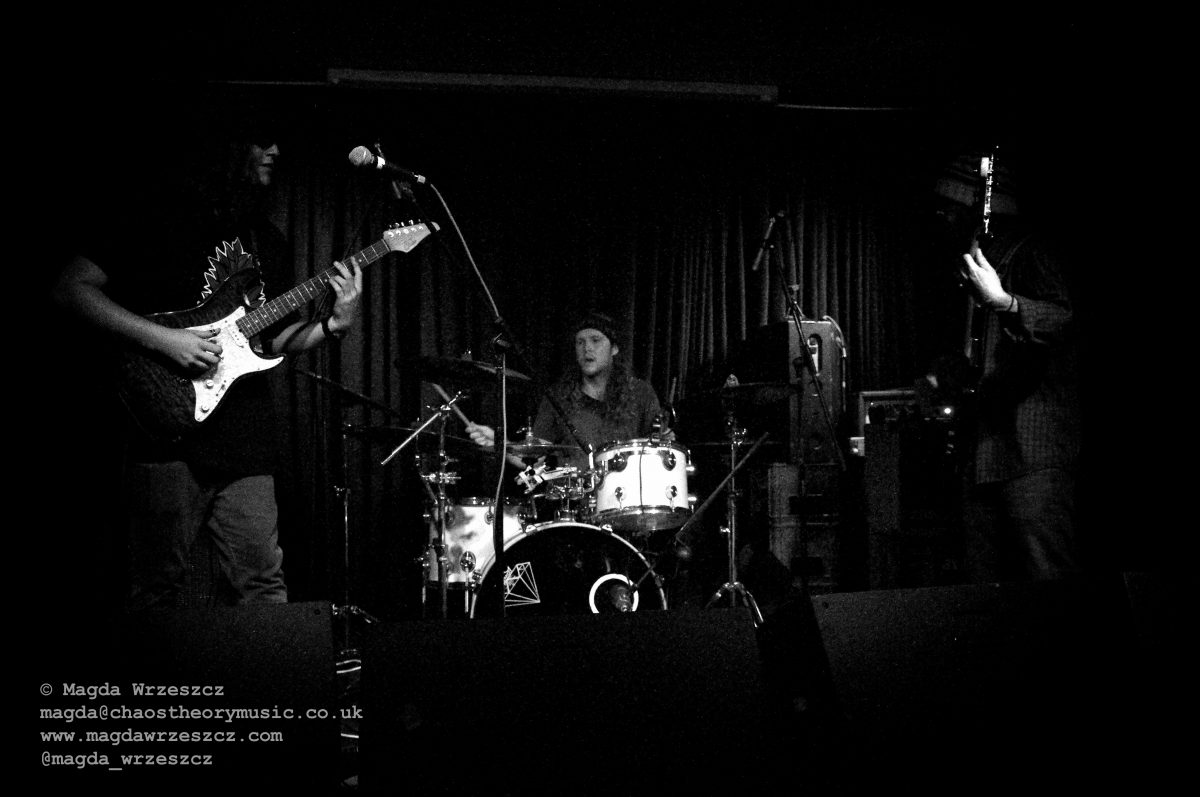
 Photo by Magda Wrzeszcz
Bassist Tommy has more than a little dose of the funk, bringing an aggressive but technically subtle feel to the sound of Patchwork Natives. This is a bass player who avoids the expected, and plays off James’s time signatures adding his own sweetness to the mix, never allowing the bass runs to get tired.
“My background is mostly jazz,” says Tommy. “And we are all massive jazz fans. And we get people saying that all the time, that they can see we are influenced by jazz.”
The influence of jazz is stark. Not just because they are a technical, instrumental band, but because there is a freedom in their live performance, that perfect balance between improvisation and composition.
“Yeah there’s not a lot of math bands out there that are bringing in jazz at the moment,” says James. “So we are listening to a lot of things, and just taking whatever we like and trying to work it into what we do. We do what we listen to so it just sort of ends up in there. We listen to a lot of Butcher Brown, like so much Butcher Brown.”
Recorded, filmed and mixed by Peter Junge
Adds Tommy: “There is more of a traditional jazz scene in Brighton, but nu jazz is kind of on its way now. There’s more people that we hang out with that are into the same sort of thing as well.”
So, so far we have jazz, folk and math rock. Not a completely unlikely combination of sounds, but unique enough to mark these guys out. Given the blend of influences, one wonders what the writing process is like. Is it a matter of stealing a riff here and there and putting it together? Or is there a more songwriterly approach to the composition, despite the emphasis on instrumentals?
Guitarist Liam maintains everything boils down to math rock, but he struggles to put a name to the sound they have.
He says: “It definitely starts from a math sound, but like we said there’s a lot more in there, so it has just become its own thing now.”
James explains that there is no fixed creative process but often things start to emerge out of a jam or improvisation.
“We jam a lot of sections, and so a lot of it just about making that work in a recording session.
“Someone might come in with like a specific part and then things form around it, and it just kind of spawns off one idea. And after a couple of weeks we get one of our songs.”
Adds Tommy: “Sometimes it takes us, like, weeks. We have really long, really intense rehearsals. Hours at a time.”
With a diversity of influences there comes a broad range of fans.
“We get a lot of old guys who are into their prog,” explains James, “and we get a lot of home-grown young fans too.”
“We get a lot guys who are into their seventies-ish sounds,” adds Liam.
“Obviously we attract a lot of musicians, so there’s that,” says James. “And then we get quite a lot who are quite analytical, people who like their jazz. But we also get our normal people, the non-musicians.”
 Photo by Magda Wrzeszcz
So what should we expect over the coming months? Is there an album on its away? A tour?
Tommy says a yes to all of the above, but given the fact that Patchwork Natives are fresh out of university, there are just few practicalities to take care of first.
“We have literally just finished uni and we are sort of trying to sort out housing situations right now. We all want to live together, and then once that’s all sorted we want to start working on an EP, two EPs actually.”
“We definitely want to tour, once we get the EPs sorted. I reckon by winter time we will have a tour sorted.”
Interview by James Black
Patchwork Natives are playing The Sebright Arms on Wednesday July 23.