Leeds-based Hieroglyph are rapidly making waves in the progressive metal world. Having already in the last year played at UK Tech Fest Bristol all-dayer and having supported giants like The Ocean and Chimp Spanner, we’re delighted to host their first ever headline spot at The Facemelter this Friday 8th August at The Black Heart.
In the run-up to the release of their debut EP Freefall (out on 18th August), we managed to catch up with them to find out how they apply the drive they have with their musical career to their writing process.
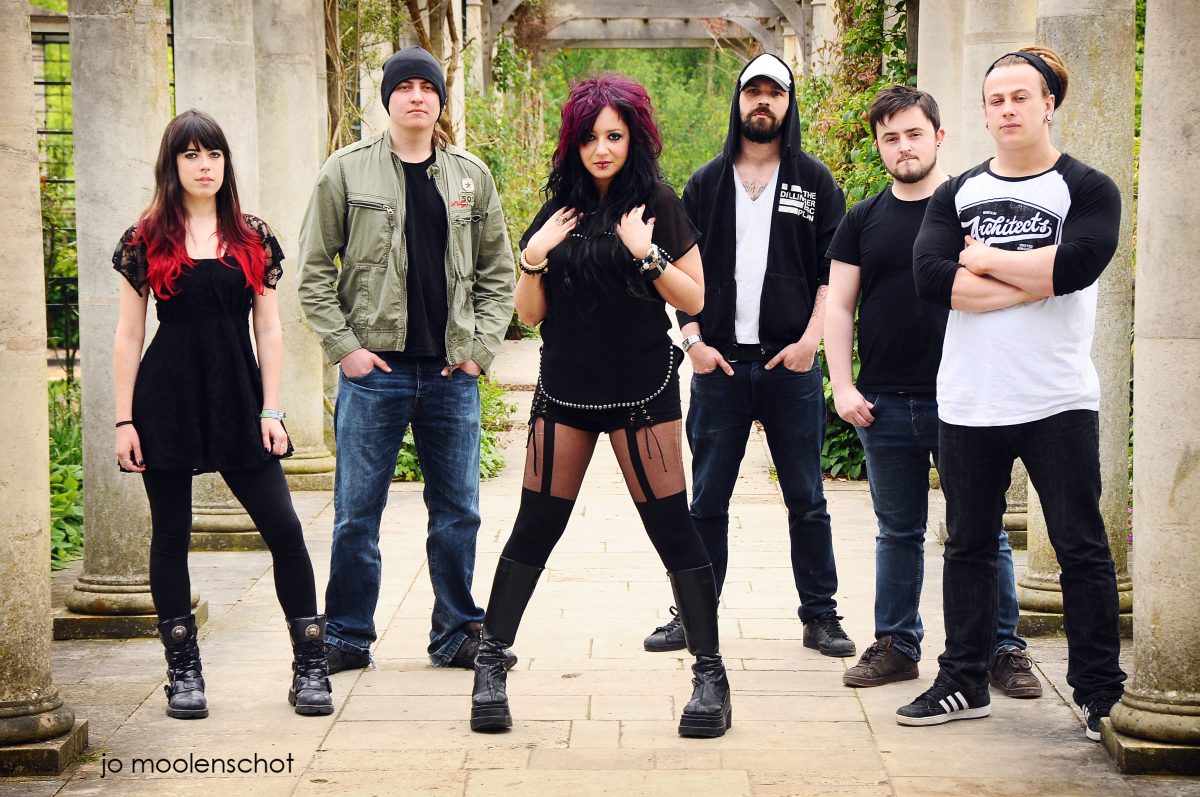
 Photo by Jo Moolenschot
——————————————-
One thing about Parasitus is that seems to be two or more songs in one. The instrumentation could stand on its own and the vocal lines have their own identity too. There is a similar effect with the keyboard work on Ozymandias juxtaposed with the heavy, driving guitars. Do you think that being a six-piece band gives your songs the edge in terms of dimensionality, compared to other bands on the circuit?
Valentina: Having 6 different people in the band with different identities, lives, ideas and influences makes the creative process amazing because that is the time where we can unify all our diversities and become one. It is obvious that the more people contribute to one idea the more the idea will take on an original shape and blend the various influences. Personally as a vocalist, I firmly believe that vocal melodies need to stand out in a song, and that is why I always try to make them sound different and edgy. This is something the tech scene is lacking sometimes in my opinion.
Sam: The writing process for the tracks so far has been largely me minus the vocals and lyrics but the great thing is, even though the writing has been quite one-sided so far, the others are never afraid to chime in and tell me what could be improved, what could be dropped, how something could be restructured, etc. Because we settled on a 6-piece line-up almost by accident and most of the music we have so far was already written without that in mind I don’t think that we’ve fully tapped into the benefits of having 6 members yet. That’s something I’m eager to explore and focus on in the near future, a more collaborative and experimental approach to writing. It could help make us less reliant on backing tracks for layers and additional instruments, who knows? That being said, I’m very proud of what we’ve written so far and the guidance of the others on getting it all perfect.
Following on from this idea of dimensionality, the single strikes me as a very perfected piece, completely polished, almost like a classical piece. Do guys work like composers, writing down musical ideas and putting them together, or is it more organic, jamming sort of process of writing?
Sam: So far, it’s pretty much been all me. Bradie arranges the drum parts to better suit his style, Val and Mark do their own thing and I give Jamie spots for leads and such because he’s a much better lead player than I am. I’ll generally smash out between 30 seconds to a minute of a demo and send it to the others, if they like it then I work on it more until it fleshes out. Sometimes, I’ll have a whole idea ready and we roll with it. I had most of the EP songs written in some form or another before the band formed. When I wrote Parasitus I actually didn’t like it that much, it was only with everyone else’s suggestions and Val bringing it up a few notches with some vocal melodies that I was sold on using it. In future, I hope that the writing process will be more collaborative; getting more input on these things always makes them a million times better.
Valentina: We are not excluding different approaches in the future, for now this has worked very well also considering we are not living in the same city.
There’s a lot of programming and production in the work you have out, so I guess there is an obvious question in how challenging is it to recreate that atmosphere and polished production sound in concert? What changes for these pieces when you perform them live?
Sam: Practically nothing, we aim to recreate the recorded sound faithfully in as much as all the sonic elements are present, but it doesn’t just sound like the recording being played back. That would be boring! The odd vocal harmony might get dropped here and there or the drums might be slightly different but not in any detractive way I think. Incorporating some live keys and backing vocals would be cool in future. But we hear a lot of good things about our live shows and sound so we’re more concerned with expanding rather than fixing anything.
Helen: The only thing that changes from the recording is the energy that comes across during the live show, which adds to the atmosphere. Playing to a backing track helps in getting the tracks to sound as close as possible to the recording but in a live setting you get an extra edge. As Sam said if everything is too polished then it can come across as quite sterile which we certainly wouldn’t want.
Filmed at The Cockpit by Dark Fable Media
The song Parasitus has quite a tight structure, it reads as a poem. It strikes me like you give equal importance and energy to the lyrics as you do to the music. That’s rare. Is it something you make a point of as a band?
Valentina: If a song is not instrumental, then the lyrics have to have a deep meaning according to me. I don’t necessarily make a point out of it, and I think in general many tech bands write awesome lyrics, but definitely I think when people listen to a song, they can relate to it, and interpret it as they want to, so lyrics are very important in this process. It is also good to give a message of my vision of the world, personally, metaphorically and socially I think.
Mark: In general Val and I share a similar world view about the human condition as cattle for a parasitic elite, this informs our lyrical themes and we intersperse the message with nods to pop culture, religion, philosophy and esoteric traditions. We put a lot of stock in lyrics and neither myself nor Val would ever be satisfied with ‘woe is me’ or nonsensical lyrics.
Where do the ideas come from in terms of lyrics? The songs have a poetic as well musical identity, so I wonder of there is a mythological landscape that informs the songs?
Valentina: There isn’t any mythological landscape, the songs are born as my experiences as a human being in the world, both personally and socially. Ozymandias is a bit of an exception, but Parasitus is the prologue of a more complicated lyrical journey that you will hear when our EP comes out in mid-August. The lyrics represent a journey through darkness to light, in a corrupted world where the media and politicians etc want to sedate and tranquilize the masses in order to lobotomize them into obedience and passiveness. The common conscience needs to awake and realise all the bullshit they feed us.
 Photo by Jo Moolenschot
Ozymandias obviously got me thinking about the Shelley poem of the same title. Is there a reference? And if so, would you say there is a political content to the lyrics, the idea of earthly power having nothing on the passage of time etc?
Valentina: Yes there is a reference. Sam gave this name to the song (I think he was watching too much Breaking Bad at the time…) and I decided to leave it and take inspiration from the Shelley’s poem which I knew already and loved after studying it in high school. However, the lyrics mean quite the opposite: time destroying everything, even the most powerful thing on earth, even a king of kings. After a while things are forgotten and everyone goes on with their lives, no matter what happened; nothing lasts forever. The poem gives already this feeling of abandonment and of erosion and disillusion, and this theme is always actual, you can’t go wrong. So with these lyrics in my head I thought I’d give it a more modern comparison to it and there you go, Ozymandias – an ode to Shelley’s poem!
Helen: I particularly like how Mark quotes the poem in the interlude section. It’s a passage in the middle of the poem so quite a subtle but direct reference. It’s a beautiful poem and I love how Val and Mark have interpreted it and incorporated it into the lyrics.
Can you give me an idea of the musical background of the band? Are you all just progressive metal artists, or are there other forms of training and musical interests that inform the playing and songwriting?
Valentina: I have a classical background: started playing piano when I was 8 and went to Conservatoire to develop my skills and studied all sorts of classical artists such as Beethoven, Mozart, Chopin, Bach and so on. I have always been listening to other things rather than metal, especially during my teen years I was totally into pop and r&b (you can probably sense the pop feeling in my melodies) and I have always been opened to any kind of music really. I just love music!
Sam: I study production and record bands, I also dabble in pretty much anything and everything musically that interests me, particularly electronic music. I had a big interest in Industrial and EBM as a teenager which I never abandoned fully, I love weird stuff like Aphex Twin and Venetian Snares. One thing I can say is that I’m a very crappy guitarist, I don’t know much theory and a lot of stuff that I write makes no musical sense, I just roll with what makes my ears happy.
Helen: I study English and music at uni but it’s mainly music history and theory and I’m also classically trained in flute and piano. I started playing bass at about 15 so I could start playing metal and I gravitated towards progressive metal simply because of the complex nature of the songs and the technicality of them which is similar to classical. They may be worlds apart but metal and classical music have a lot of parallels.
Jamie: I’ve been playing guitar since i was about 13/14 as well as a bunch of other instruments but with guitar I had lessons for a few years both electric and classical. I like a lot of other stuff besides progressive metal, pretty much anything that sounds good to me, all kinds of genres old and new. I know a fair bit of music theory too which makes everything a sh*t load easier. I’m always trying to learn new stuff whether it’s a song I really like or just more theory, there’s plenty to go at.
Mark: Being a tech based band that is the common denominator of our influences, but personally I am from a more hardcore background when it comes to playing and I think that’s represented in what you could generously call my ‘style’.
In terms of progressive metal, what other bands do you listen to, and does their work inform the output of Hieroglyph?
Valentina: My biggest influence in terms of melodies and lyrics in the djent/proggy world at the moment are Periphery, Tesseract and Skyharbor. These bands are just class and top notch.
Helen: We all listen to loads of progressive metal bands: Sikth, Between The Buried and Me, Meshuggah, Heart of a Coward, Periphery, Monuments etc.. and they’re all a big influence on ideas of how we want Hieroglyph to sound. However on the flip side through listening to these bands we know how we want Hieroglyph to be different and will immediately pick out something that needs changing, e.g. “That riff sounds too Monuments-esque, we need to alter it.” It helps us to keep coming up with fresh ideas.
Mark: I’m more into traditional prog really: Rush, King Crimson, or even some of the fusion bands of the similar era like Mahavishnu Orchestra or Zappa. More modern prog is difficult to define; I see bands like Cult Of Luna adopting prog influenced progressions but they rarely get branded as such, I think The Ocean tick all the boxes for me when it comes to contemporary progressive metal. I tend to listen to jazz, folk or blues in the car though, a lot of players and acts in those scenes seem freer to express themselves, in prog/tech metal I worry that we are bound by too many rules and can end up copying the scene godfathers rather than expanding on the basis they laid down.
Jamie: Between The Buried And Me, Animals As Leaders and Tool. these three bands are probably the three main “progressive metal” bands that have affected my playing the most.
Sam: Bradie jokes that there aren’t any tech bands that I don’t like (not true!). I have to say Periphery and Sikth because they kicked off my interest in this stuff and taking my instrument and recording seriously. I really love Uneven Structure because they create these massive soundscapes, simple-but-perfect vocals and mechanical riffs which are not virtuosic or show-offy, just a big slab of epic, spacey goodness. Genius stuff. I’m a big King Crimson fan too (Belew era stuff mainly), craziest band ever. I like stuff which has appeal beyond sheer technicality or shredding, that very much influences my approach. Be as technical or as simple as you like, just make sure the songs still sound class!
Interview by James Black