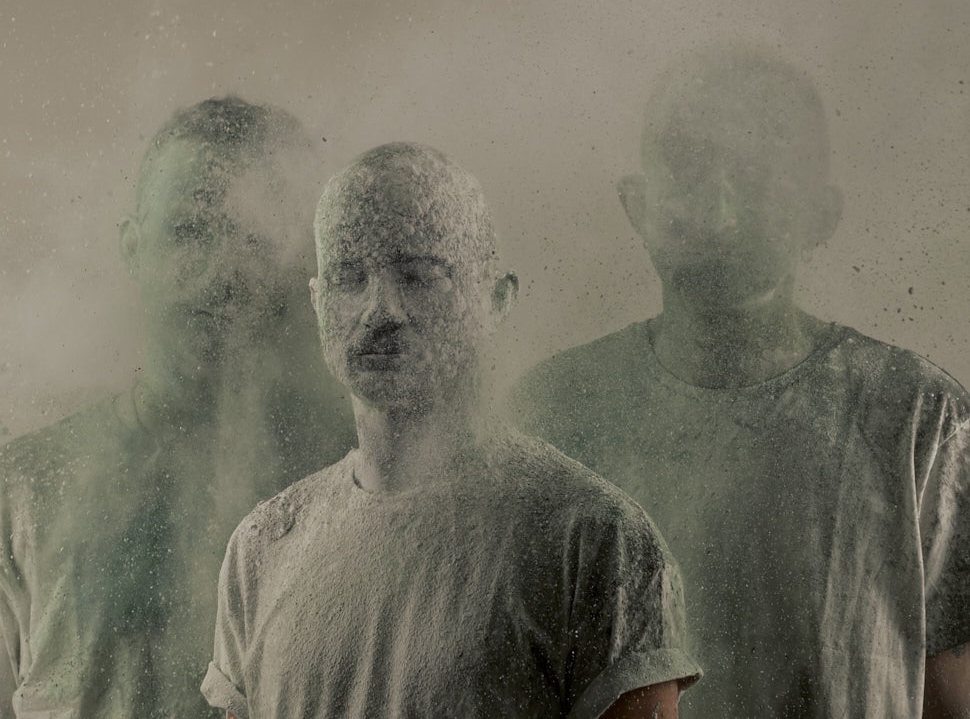
Teeth Of The Sea: Three musicians from London, all covering a lot of insanely good instruments. Listening through their discography you’ll find darkwave and synths merging with siren-like melodies, colourful psychedelia playfully circling around Latino riffs. Behind this avant-garde infusion lie Sam Barton (trumpet, bass guitar), Mike Bourne (programming, electronics, percussion) and Jimmy Martin (guitar, synths and tapes).
Mixing multiple genres may not be something new – after all, one of Chaos Theory’s aims is to promote musicians who push the traditional boundaries of musical styles and expectations. Yet Teeth of the Sea have managed to orchestrate this into their unique signature style which promises an otherworldly experience, personal to them.
While less gritty than Highly Deadly Black Tarantula (2015), their most recent album Wraith (2019) is a sublime fusion of futuristic alternative music and a classic sultriness: a femme fatale for your ears. In fact, this entire album is a visionary aural cinematic journey. There are echoes of the dystopian Blade Runner: futuristic curiosities mixed with moments of brooding trumpet, which clash head on with rocky guitars and ambient electro synths of sci-fi and 80’s movies. Wraith is an ever-changing voyage which takes you out of your body and into as many adventures as you can devise.
I found myself drawn right in with the steady, Aphex Twin-esque electronic rhythms in the opening song I’d Rather, Jack, when I’m delightfully surprised as gritty, distorted guitar enters the scene. Following with the extremely popular Hiraeth, this 7-minute track exudes a sophistication which is intrinsically connected to TOTS’s unique sound. Their use of the leisurely trumpet brings forth elements of film noir, followed by guitar strings, slow, steady and sexy. I can feel this song taking the hand within my mind and leading me into that dark back room through the flickering neon lights of a low-lit, smoky bar. Where am I going? I may not know yet, but there’s no way I’m backing out now…
The rest of the album is just as all-encompassing, and well worth the four-year wait since their last release. It’s slinky and atmospheric, but without losing the sense of energy from previous releases. The wild fluttering of Wraiths on the Wall is quickly grounded by the intense, rhythmic synths of Our Love Can Destroy This Whole Fucking World – and I’m left believing the title.
TOTS have evolved once again, unsurprisingly, staying true to their much-loved constant innovation.
Interview with Teeth Of The Sea
Natalia: You’ve had few band member changes yet you’ve gone through a lot of variations, musically. What’s it been like working together and balancing different musical ideas while continuously evolving as a band?
Sam: Whilst Mike, Jimmy and I have been there throughout, we’ve [actually] had a bunch of other members and contributors who’ve all helped shape whatever we were doing at the time. The initial 2006 line-up included Darren Strickland and John Hirst. Darren left pretty early on but was definitely part of the original ‘vision’, such as it was.
John remained throughout the recording of our first album Orphaned By The Ocean but left just before it was released in 2009, when he was replaced by Mat Colegate. Mat was in the band until 2017 and helped write and record everything through Hypnoticon EP (2010), Your Mercury (2010), Master (2013), A Field In England (2014) and Highly Deadly Black Tarantula (2015). Wraith is the first record we’ve made just as a 3 piece and even then, we had great contributions on individual tracks from Kathy Gifford, Chlöe Herington and Valentina Magaletti.
We’ve always made a conscious effort to make each new project a step on from the previous, to make different sounds and tell a different story, to keep ourselves interested as much as anything. There’s never really any great master plan behind this – we all talk about what we all want to do with the record, what music, films, books or art we’re currently being influenced by; how we all feel and what sort of atmosphere we want to create. Then we throw a load of stuff in the pot and it invariably comes out sounding nothing like what any of us planned or expected!
“It’s usually a combination of ideas […] wilful experimentation and hell-for-leather racket in the rehearsal room and judicious collective editing of the end result.”
Do specific members take the lead on the different genres, which combine to make the signature feel to a TOTS song?
There’s no hard and fast rule to how a TOTS track is written and who contributes what. It’s usually a combination of ideas we might have been working on individually at home, wilful experimentation and hell-for-leather racket in the rehearsal room and judicious collective editing of the end result.
I actually find it really hard to talk about the process of how we write and who does what. I suspect if we try to analyse it too much, we’d tie ourselves in knots. In terms of musical influences there’s a huge amount of crossover in what we all like but everyone brings their own thing to the table. To be reductive, I’d say that Mike takes the lead on the more techno/ambient side of things, Jimmy brings the metal/psychedelia/noise rock and I bring the jazz/Morricone brass, however that only really tells part of the story. We all stray into each other’s territory a fair bit and hopefully create a bunch of new territory all our own. Ultimately, I just hope we’re all working to serve the track rather than stamp our own personal identity on anything and when something works for us, it’s almost always because that’s what’s happened.
13 years of TOTS
In previous interviews, you’ve mentioned that being in Teeth of the Sea doesn’t make you money; going for 13 years (to date) despite of this is a great example of continuing musically because it is a labour of love, or a cathartic, necessary experience. What does being in Teeth of the Sea mean to you?
It’s a weird one. I certainly wouldn’t want to sound hard done by on the money front. The band has given us tons of amazing opportunities to travel and play in countries I may never have visited otherwise. We’re also in a position where we’re able to pay to record in a good studio, hire a sound engineer and driver to tour with and not really lose any money individually on it.
As an underground band in this day and age this is often as good as it gets, so I don’t take these things for granted. And, whilst I’m never going to pretend I wouldn’t love to do this full-time, having a job outside of music to look after rent, food etc. does mean you have more freedom to make the music as batshit as you want without worrying about its appeal or audience too much.
The downside for me is never finding time to switch off. When I’m working, I’m anxious about what needs to be done with the band, when I’m not at work I’m sometimes too exhausted to be at my best creatively but have too much on to properly unwind. But hey, that’s a ‘world’s smallest violin’ moan really, show me an adult who doesn’t feel like that! By and large I just feel very lucky to have been involved in this band for the last 13 years, making records, playing shows in amazing places, meeting great people and generally having a fantastic time!
That does sounds pretty awesome! So in 13 years, what’s the weirdest or most memorable response you’ve received to your music?
After we played Supersonic festival in 2011 a guy thought we were so awful that he told me if we ever played in Leeds, he’d personally kick my head in (the joke was on him – we’d already played there). Another time someone told Jimmy that their kid was conceived to our music. Is that what’s known as ‘polarising an audience’?
Wraith (2019)
Let’s talk about your most recent album, Wraith. I tried to not bring up the word ‘cinematic’ as so many others have, but it fits so well! So here it goes: this is a beautifully designed album which feels like a cinematic journey through multiple genres. It’s incredibly engaging and hypnagogic. How was it conceptualized? I’ve read that the studio you used was on a boat…?
It’d be extremely disingenuous of us to criticize anyone using the word ‘cinematic’ when describing us as we’re clearly hugely influenced by cinema and soundtrack artists like Morricone, Tangerine Dream, Goblin, Ben Frost etc. The word does crop up a lot, but I guess we made a rod for our own back there when we made our music so damn… ‘cinematic’.
The bulk of Wraith was recorded in SOUP studios by Giles Barrett. SOUP is a decommissioned lightship moored at Trinity Buoy Wharf in the Thames. When the tide comes in you can feel the floor bobbing on the undulating Thames which gives the sessions this nicely woozy feel. It’s a fantastic space and one we feel very comfortable in, having already recorded Master, A Field In England and Highly Deadly… there.
The first few tunes we wrote for Wraith were I’d Rather Jack and Gladiators Ready i.e. The Bangers. We were initially looking to create something widescreen and technicolour from that, but as sessions continued and new material added, it acquired this more eerie and uncanny side to it. This happened pretty organically and certainly wasn’t planned. As I said earlier, our albums will frequently go off in directions none of us had anticipated but sometimes you just have to go with it. Really glad you liked it though and thanks for the very nice description!
Vocals and narrative
You don’t often use vocals, and for songs like Fortean Steed where you do, the use is less lyrical and more like an additional instrument. How do you decide when to use them and when they aren’t a necessary addition?
Absolutely – we do actually use more vocals than people maybe realise but generally in a very textural/instrumental way, or deliverer of narrative/melody (e.g. the male voice drones at the start of You’re Mercury or the vocoder on Responder). For Fortean Steed Jimmy had an idea in Latin that he wanted to try out which was sung by the previously mentioned Kath Gifford, with these overlapping phrases like people singing a round. I think the use of non-English language further invites you to listen to it in phonetic terms rather than infer direct meaning much in the way that, for example Liz Frazer sang in Esperanto on a lot of Cocteau Twins songs. I love Kath’s voice and I really love the way this came out – which I’m allowed to say as I genuinely had no input on this bit!
“I think the use of non-English language further invites you to listen to it in phonetic terms”
A brief pre-Wraith history of TOTS in 4 tunes
Looking back through your entire discography, are there any songs which hold particular meaning to you?
OK, if I may I’ll do a very brief pre-Wraith history of TOTS in 4 tunes:
- Only Fools On Horse (off Orphaned By The Ocean, 2009): This is the first actual tune I can remember us writing (I might be mistaken) and definitely the first moment I thought we might be capable of coming up with some really cool stuff. Mike was running a great low end distorted drone with a basic filtered rhythm, John came up with a nice repetitive bass figure, Jimmy was honing his high-end, multiple delayed guitar sprays and I came up with a vaguely Arabic-sounding melody over the top. Job done; I seem to recall it took as much time to write as it does to play.
- A.C.R.O.N.Y.M. (off Your Mercury, 2010): I remember laughing a lot when we wrote it, like “we can’t possibly pull this off, can we?”. The fact that we did was a big confidence boost in terms of what we imagined ourselves capable of. Mike came up with A BIG Jarre/Vangelis synth arpeggio and we all felt we had to somehow match that in terms of scale. Mat added the big glam gallop on the drums, I chipped in with my best attempt at a repetitive, Holger Czukay-esque bass line and Jimmy gave it some stadium Fripp on the guitar, et voila! Pretty much became an instant live favourite (with the band at least) and I think we then played it at virtually every gig for the next 7 years.
- Responder (off Master, 2013): This starts with that bass note hammering away which just sounded huge straight away and felt pretty easy to come up with a trumpet melody. Jimmy also had some strong melodic ideas that are totally different to mine, but everyone gives each other loads of breathing space to do their bit. It’s like a story unfolding, building, until the tension gets too much and explodes into the biggest TOTS banger of all. Master went on to get significantly more press than anything we’d done before, nearly all of it really positive, and off the back of that and around that time we got to play SXSW, Latitude, London Short Film Festival, CERN, Transylvania International Film Festival and Milhoes De Festa. It was a magical time and I’ll always associate Responder with that period.
- Love Theme (off Highly Deadly Black Tarantula, 2015): We wrote this initially for a concert we did at CERN in Geneva in March 2014 – they’d invited us to compose and perform a live soundtrack to Michael Radford’s film of 1984 as part of their film festival there which was themed around surveillance and privacy. So, we got to make a load of horrible experimental noise on a stage about 100 metres away from the Large Hadron Collider. It was absolutely nuts, an experience I’ll never forget. This was really the only track that survived from the performance to make it onto the next TOTS album but it’s one of my favourite tracks we’ve ever done. I actually feel my own contribution is fairly minimal because what Mike, Jimmy and Mat were doing is so pitch perfect it didn’t really need anything else. A beautiful, ‘I Care Because You Do’ era Aphex-esque synth, some Badalamenti style guitar underpinning it and scary/sad detuned spoken word stuff. Ended up as the closing track on Highly Deadly Black Tarantula.
Live performances
That is quite a summary! Between them all, would you say Wraith is a more spiritual album than previous ones?
It’s not something I’ve consciously considered. I guess all three of us are thinking about a lot of different things when we make music together, but the most common things we talk about in terms of our aims tend to be visual and atmospheric. That’s not to say that the music can’t be spiritual to somebody listening to it or even to us in some way, it’s just not something we’ve talked about or a term I’ve used in thinking about it. On the whole we purposefully avoid trying to make definitive statements about what any of our music means or represents. I’d like to leave it up to the listener to discern their own meaning in it, if that doesn’t sound too vague.
Does it feel different playing Wraith live than previous albums?
Initially, maybe because it was the first time we toured as a 3-piece. Once we got a few shows under our belts and were in the swing of things I stopped thinking about that. We also still play older material which again took a bit of reworking in some instances, but now I’m really happy with how everything is working live.
Do you have people up and dancing or more mesmerized by the music?
A bit of both really, although live we tend to keep quite an up tempo. I love nothing more than seeing people dance to our music, it’s an absolute rush, but similarly you sometimes see people with their eyes closed and hands in the air which is great also.
10 Years of Chaos festival
Thanks for such a great interview guys. To finish off, how does it feel to be part of the 10 Years of Chaos festival in February?
Really great! I’ve met Kunal a few times and he’s a lovely chap and has been putting on great shows all these years, so very chuffed to be asked to play such a big Chaos Theory show despite not having done one before. It’s an absolutely blinding line-up with the likes of Zu, Arabrot, Vodun and David Terry who we’re all fans of and a great venue in The Dome; we’re honoured to be involved. Can’t wait!
Written by Natalia Joruk
10 Years of Chaos will take place at joint venues The Dome, Tufnell Park and Boston Music Room on 29th February 2020, followed by the Towards Collapse Takeover from 11pm- 3am. Buy tickets here.