Jo Quail is a poet. All the elements are there. The lyricism, the inspiration, and mysterious ability to render the complexity of the subjective experience in such a way that it can be shared.
The only difference between Jo Quail, and most other poets, is that she doesn’t use words. Her lyricism comes from the vividness of her musical phrases and licks. The inner voice remains just that – inner.
 Photo by Magda Wrzeszcz
The cello speaks, and the things it says to us are the things we might normally wish to avoid. All the home truths and ambivalent emotions, all the grief and primal desire, the sounds of our loneliness echoing back to us with terrifying accuracy.
This is an artist whose creative energy emerges out of a great cocktail of influences, experiences and musical tastes.
Given Jo’s background as a musician, this is not surprising.
“I started years and years ago when I was five,” she explains. “All my training was through the Centre for Young Musicians, and so I had exposure to a classical music environment, but equally there was a lot of encouragement, even at a young age, to compose, improvise and that was a big part of what we did. So, that’s all become very useful now.”
Apart from this solid grounding in the technical side of music, Jo is an unabashed fan of other forms of music that rely on rather more primal resources to make their point. The mixture of these styles plays an important part in forming her voice as an artist.
She says: “I love to listen to Bach, but equally I love to listen to good rock music. It’s a bit of a melting pot, hence the name of the new album Caldera, a cauldron. Everything I experience, all areas of my life, kind of end up going into effectively a sort of melting pot, all that comes out in the music.”
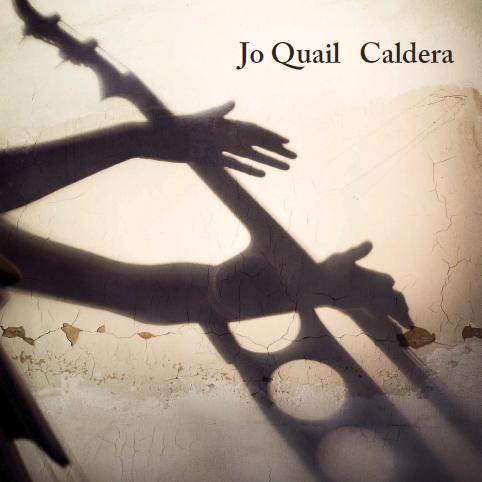
 Caldera album cover design by Karolina Urbaniak
With this grounding in the classical, and a love of styles that are more personal to her, you would expect Jo to be oozing with confidence when it comes to her creative process. As with all great poets, however, that very process is fraught with uncertainty, anxiety and long, long periods of radio silence.
“It’s very funny because it definitely goes in waves,” says Jo. “When you are in a fallow period, you never ever remember that you go to this place regularly, and you think it’s the last time you are ever going to write anything.”
So what happens when things start to emerge in her mind? Do those compositions come to her ready made, or is the process more arduous, as perhaps the texture of her work suggests?
Jo explains that the sense of place, the sonic landscape that we enjoy so much in her work, is there from the beginning, and is often a starting point.
“The cauldron is one image,” she explains, “but when I begin to write I have a distinct landscape that I am in. I don’t go into great meditations or anything, I would love to be able to, but I do have a very strong image in my mind of a place and one of the pieces on the new album actually is about this place. And it is a very, very sparse landscape. There’s rocks and low clouds and things like that.”
Video directed by Richard Wakefield of FX Media
She adds: “The funny thing is that it’s a place that I am quite reluctant to go to. I put it off as much as I can until it kind of seems I can’t put it off any more and I have to go there, and start playing and things begin again.
“It’s very funny because you think you would be over the moon about the prospect of writing new music, but at that moment this place is very sparse, and the possibilities are enormous. And it’s something about having to take that level of responsibility. You have to do justice to it.”
Jo describes the inception of South West Night, which is on the new album. In the emergence of that work, the landscape was a real, material place in Australia.
“It was literally a moment when everyone else had gone, before a concert and there was just this amazing silence. I had experienced it before, again in Australia, and you realise silence is enormous. And if you stop and listen, you think it’s silent, but of course it isn’t, it’s actually deafeningly noisy. The sounds of the earth, the sounds of the trees, the insects, all the the things which we filter out usually. Particularly on South West Night, there was also this sky. It was literally enormous.”
South West Light – A Photographic Perspective by Michael Fletcher, soundtracked by Jo Quail
Working largely with instrumentals, with only a few exceptions, Jo believes this gives her the advantage when it comes finally playing her work to an audience. Despite the vividness of her personal creative process, Jo loves the fact that her musical impact changes according to the audience.
“That’s the beauty of not having lyrics,” she explains, “because you cannot tell people what it is about. Sometimes at concerts I talk too much, and sometimes I say very little. I would actually prefer to say hardly anything at all, and just sit there and play the piece.”
Having said all this, Jo’s work is imbued with the influence of the written word. A huge fan of poetry, in particular T.S. Eliot, Jo believes that the cello as an instrument, has unique vocal qualities that capture the shape and texture of the human voice.
“There are a couple of times I have used a vocalist, but apart from that, the cello itself is the great voice of all the instruments. It is closest I think in timbre to a human voice, and the way that you can play the cello, the inflections, you can make the instrument speak.”
The levels of meaning Jo manages to draw out from her music reflect a relationship with words that feeds into how she thinks about form, meaning, and the power of sound.
She adds: “Often my pieces have secret words, which are for me if you like. T.S. Eliot’s Four Quartets – that piece of writing, I read that often. You know when you read something, not for the meaning but just for the sound? He’s very powerful like that, and he is also extremely powerful if you actually read into the work.”
The experience of conveying meaning before meaning is fully comprehended was most acute for Jo on her last album in the making of Colour of Water, with Hindi poet Mohan Rana.
“He recited a poem which turned but to be called Colour of Water, but at the time I didn’t know what the piece was about but I loved his voice,” she recalls. “So wrote this sort of plinky-plonky watery piece, and it turned out that his poem was about rain.
“I think it goes to show that instrumental music is just as informative and evocative as a piece of literature, if you wish to, again, take the responsibility for yourself and follow the path of it.”
Communicating on this primal level, transferring meaning in a pre-conceptual way, was brought out more starkly for Jo by watching her little girl Eila learn to speak.
“I can tell you many things that she was talking about before she could even formulate words. So again there was the direct experience of listening to something and talking without necessarily using an understandable language. I am her mum, so that helps, but even then, it just reaffirms for me that we can convey many, many things through sound.”
Given that so many new ingredients will be going into the cauldron, will the new album mark a shift in Jo’s voice as an artist?
“I think albums are snapshots in time of a period in your life. On my first album I had had some quite heavy duty personal changes in my life, and I was still a fledgling grown up. And I think that album was quite reflective, quite introspective.
“This new one is not vastly different, in some respects, but the way I approached it, what’s different is the place I began at, when I started to write it. There are some up-beat, bigger pieces, in there, but there are also some very exposed solo bits as well.”
Jo believes the personal changes in her life will be evident on the new album. Particularly the experience of being pregnant with Eila and becoming a mother.
“Sometimes I am talking about very sensual elements, other times it’s quite primitive. Or primal maybe, in its essence. Partly because, when I was writing it, the majority of it was written when I was pregnant. So the whole album was very physical, it’s about black and brown earth, and blood and fire, and all these things which sound a bit Game of Thronesey, but that’s where I was.
“Having a small person on board, there’s nothing like that to give you a bit of focus. Because, whereas with the first album, I could languish about for days on end, with this one, I had ten minutes here and there to attend to whatever needed attending to.”
Despite the new challenges, and having become more sure about her voice as an artist, the task of bringing to life her moments of inspiration, is the continuing theme of her life and her work. Like a poet, or like a sorceress conjuring spells, the artistic process for Jo Quail is about getting to the essence of piece, doing whatever it takes to remain true to the original roots of the work.
Jo live at St Leonard’s Church, recorded by Peter Junge
Again, the issue of ‘responsibility’ to her art appears to be the recurring challenge.
As Jo herself explains: “If you come from a classical background, you realise that everything is built on about three notes fundamentally, including Status Quo, and some Beethoven, so you can actually boil it down, and that’s what I call the DNA of the music. Most of the time, the DNA of the music is probably only a tiny phrase. That’s the little shoot that comes up, and then the gardener takes the responsibility.”
Interview by James Black
 Jo’s new logo, designed by Alex Unku